
Pharmakokinetik: Eine analytische Lösung zur Berechnung der Aufnahme-Halbwertszeit aus dem Zeitpunkt der maximalen Plasmakonzentration
Problemstellung
Wir betrachten eine für die Pharmakokinetik/Pharmakodynamik (PK/PD) relevante Parent-Metabolit-Kaskade:
\[ A \xrightarrow{k_f} B \xrightarrow{k_e} C, \]wobei \(A\) der verabreichte Parent (oder Prodrug) ist, \(B\) der aktive Wirkstoff ist, der den pharmakodynamischen (PD) Effekt antreibt, und \(C\) ein inaktives Produkt ist, das anschließend ausgeschieden wird. Die Entfernung von \(C\) ist für den Zeitverlauf von \(B\) irrelevant und wird durchgehend ignoriert.
Klinische/PD-Verknüpfung. Angenommen, der pharmakodynamische Effekt wird direkt und augenblicklich durch die Konzentration des aktiven Metaboliten angetrieben, \(E(t)\propto B(t)\). Folglich ist der Zeitpunkt der maximalen Wirkung gleich dem Zeitpunkt der maximalen aktiven Metabolitenkonzentration, bezeichnet als \(t_\text{peak}\).
Bekannt
- Eliminationshalbwertszeit des aktiven Metaboliten \(B\): \(T_{B\to C}>0\), was die Eliminationsrate erster Ordnung \(k_e=\ln 2/T_{B\to C}\) ergibt.
- Beobachtete Zeit bis zur maximalen aktiven Metabolitenkonzentration (und Wirkung): \(t_\text{peak}>0\).
- Anfangsbedingung entsprechend einem IV-Bolus (Dosis normalisiert): \(A(0)=1,\;B(0)=0\).
Das Ziel ist die Berechnung der Bildungshalbwertszeit vom Parent zum aktiven Metaboliten: \(T_{A\to B}=\ln 2/k_f\) basierend ausschließlich auf den bekannten Parametern.
Pharmakokinetisches Modell
Dies ist eine lineare, einseitige, erster Ordnung-Kaskade ohne Rückkopplung:
- Bildung von \(B\) aus \(A\) mit Rate \(k_f\) (Einheiten: 1/Zeit). Pharmakologisch erfasst \(k_f\) das Netto-Erscheinen des aktiven Wirkstoffs aus seinem Vorläufer (z.B. metabolische Aktivierung), unter der Annahme, dass die Verteilung im Verhältnis zur Bildung/Elimination für diese vereinfachte Analyse schnell ist.
- Elimination von \(B\) mit Rate \(k_e\) (Einheiten: 1/Zeit), die durch die gemessene Halbwertszeit \(T_{B\to C}\) bestimmt wird.
Die Massenbilanz-ODEs sind
\[ \dot A(t)=-k_f A(t), \qquad \dot B(t)=k_f A(t)-k_e B(t), \]mit \(A(0)=1\) und \(B(0)=0\). Diese implizieren
\[ A(t)=e^{-k_f t}. \]Einsetzen in die \(B\)-Gleichung ergibt eine lineare ODE mit bekanntem Input \(k_f A(t)\). Lösung (via Integrationsfaktor) ergibt, für \(k_f\neq k_e\),
\[ B(t)=\frac{k_f}{k_e-k_f}\Big(e^{-k_f t}-e^{-k_e t}\Big),\qquad t\ge 0. \]Interpretation. \(B(t)\) ist die Differenz zweier Exponentialfunktionen: Sie steigt anfangs, wenn die Bildung dominiert, und fällt dann, wenn die Elimination dominiert. Das Maximum tritt dort auf, wo der momentane Zufluss und Abfluss von \(B\) gleich sind.
2) Peak-Zeit des aktiven Metaboliten (und der Wirkung)
Differenziere \(B(t)\) und setze auf Null:
\[ \frac{dB}{dt} =\frac{k_f}{k_e-k_f}\Big(-k_f e^{-k_f t} + k_e e^{-k_e t}\Big)=0 \quad\Longrightarrow\quad k_f e^{-k_f t}=k_e e^{-k_e t}. \]Natürliche Logarithmen nehmen:
\[ \ln k_f - k_f t = \ln k_e - k_e t \;\;\Longrightarrow\;\; t_\text{peak}=\frac{\ln(k_f/k_e)}{\,k_f-k_e\,}. \]Diese Formel ist dimensionskonsistent (Zeit auf beiden Seiten) und gültig für \(k_f\neq k_e\).
Sonderfall \(k_f=k_e\). Mit der Regel von l’Hospital oder durch Lösen der degenerierten ODE findet man
\[ B(t)=k_f t\,e^{-k_f t},\qquad t_\text{peak}=1/k_f=\frac{T_{B\to C}}{\ln 2}, \]d.h. wenn Bildung und Elimination gleich schnell sind, tritt das Maximum bei einer mittleren Lebensdauer auf und \(T_{A\to B}=T_{B\to C}\).
3) Invertieren der Peak-Zeit-Formel zur Bestimmung von \(k_f\)
Unser Ziel ist die Berechnung von \(k_f\) (und damit \(T_{A\to B}\)) aus dem bekannten \(k_e\) und dem beobachteten \(t_\text{peak}\). Definiere das dimensionslose Verhältnis
\[ r \equiv \frac{k_f}{k_e}>0,\qquad a \equiv k_e\,t_\text{peak}=\frac{(\ln 2)\,t_\text{peak}}{T_{B\to C}}>0. \]Die Peak-Zeit-Beziehung wird zu
\[ a=\frac{\ln r}{r-1}. \]Diese transzendente Gleichung hat eine geschlossene Lösung mit der Lambert-\(W\)-Funktion. Vorgehen wie folgt:
\[ \begin{aligned} a(r-1)&=\ln r &&\Longrightarrow& e^{a(r-1)}&=r\\ &&&\Longrightarrow& r\,e^{-a r}&=e^{-a}\\ &&&\Longrightarrow& (-a r)\,e^{-a r}&=(-a)\,e^{-a}. \end{aligned} \]Per Definition der Lambert-\(W\)-Funktion (\(W(z)\,e^{W(z)}=z\)) identifizieren wir
\[ -a r = W\!\big(-a e^{-a}\big) \quad\Longrightarrow\quad r = -\frac{1}{a}\,W\!\big(-a e^{-a}\big). \]\(k_f=r\,k_e\) zurückgewinnen, dann in die gewünschte Halbwertszeit umwandeln
\[ \boxed{\;T_{A\to B}=\frac{\ln 2}{k_f} = -\,\frac{(\ln 2)\,t_\text{peak}}{\,W_b\!\big(-a e^{-a}\big)}\;}, \qquad a=\frac{(\ln 2)\,t_\text{peak}}{T_{B\to C}}. \]Was ist Lambert \(W\)? Es ist die mehrwertige Umkehrfunktion von \(x\mapsto x e^{x}\). Viele wissenschaftliche Bibliotheken implementieren sie als
lambertw. In unserem Fall liegt das Argument \(z=-a e^{-a}\) in \((-e^{-1},0)\), wo zwei reelle Zweige existieren: der Hauptzweig \(W_0\) und der untere Zweig \(W_{-1}\).
Zweigauswahl (warum zwei mögliche \(W\)’s und welcher zu verwenden ist?)
Die Abbildung \(r\mapsto a=\frac{\ln r}{r-1}\) ist monoton fallend für \(r>0, r\neq 1\), mit Grenzwerten
\[ \lim_{r\to 0^+} a=+\infty,\qquad a(1)=1,\qquad \lim_{r\to\infty} a=0^+. \]Daher:
- Wenn \(r<1\) (Bildung langsamer als Elimination, $k_f<k_e$), dann $a>1$ (Maximum tritt nach einer mittleren Lebensdauer von \(B\) auf).
- Wenn \(r>1\) (Bildung schneller als Elimination, $k_f>k_e$), dann $a<1$ (Maximum tritt vor einer mittleren Lebensdauer von \(B\) auf).
- Wenn \(r=1\), dann \(a=1\) (der Sonderfall oben).
Für \(z=-a e^{-a}\in(-e^{-1},0)\) verhalten sich die beiden reellen Zweige wie:
- \(W_0(z)\in(-1,0)\) \(\Rightarrow\) ergibt \(r\in(0,1)\).
- \(W_{-1}(z)\in(-\infty,-1]\) \(\Rightarrow\) ergibt \(r\in[1,\infty)\).
Regel (in Bezug auf Beobachtungsgrößen):
\[ b=\begin{cases} 0, & a\gt 1 \quad (\text{verwende } W_0 \Rightarrow k_f \lt k_e \Rightarrow T_{A\to B} \gt T_{B\to C}),\\ -1,& a\lt 1 \quad (\text{verwende } W_{-1} \Rightarrow k_f \gt k_e \Rightarrow T_{A\to B} \lt T_{B\to C}),\\ \text{beliebig},& a=1 \quad (\text{ergibt } k_f=k_e). \end{cases} \]Endgültige geschlossene Lösung (einsatzbereit)
Sei
\[ a=\frac{(\ln 2)\,t_\text{peak}}{T_{B\to C}},\qquad z=-a e^{-a}. \]Dann
\[ \boxed{\;T_{A\to B} = -\,\frac{(\ln 2)\,t_\text{peak}}{\,W_b(z)\,}\;}, \]mit Zweig \(b\), gewählt über die Regel oben (vergleiche \(a\) mit 1).
Einheitenprüfung. \(a\) und \(z\) sind dimensionslos. Der Zähler hat Einheiten von Zeit, \(W_b(z)\) ist dimensionslos, also hat \(T_{A\to B}\) Einheiten von Zeit (wie erforderlich).
Praktische Hinweise
Benötigte Eingaben.
- \(T_{B\to C}\): die terminale Halbwertszeit des aktiven Metaboliten \(B\) (aus Konzentrations-Zeit-Daten).
- \(t_\text{peak}\): die Zeit der maximalen Wirkung (oder maximales \(B\), falls verfügbar). Falls die Wirkung verwendet wird, stellen Sie sicher, dass die Wirkung direkt proportional zu \(B\) ohne Verzögerung ist (keine Hysterese).
Berechnen Sie das dimensionslose \(a\).
\[ a=\frac{(\ln 2)\,t_\text{peak}}{T_{B\to C}}. \]Wählen Sie den Zweig.
- Wenn \(a>1\): verwenden Sie \(W_0\) (Bildung langsamer als Elimination).
- Wenn \(a<1\): verwenden Sie \(W_{-1}\) (Bildung schneller als Elimination).
- Wenn \(a=1\): \(T_{A\to B}=T_{B\to C}\).
Berechnen Sie \(T_{A\to B}\).
- Berechnen Sie \(z=-a e^{-a}\), dann evaluieren Sie \(W_b(z)\) in Ihrer Mathematik-Bibliothek; schließlich berechnen Sie \(T_{A\to B}=-(\ln 2)\,t_\text{peak}/W_b(z)\).
Plausibilitätsprüfungen.
- Wenn \(t_\text{peak}\) sehr früh relativ zu \(T_{B\to C}\) liegt (kleines \(a\)), sollten Sie \(T_{A\to B}\ll T_{B\to C}\) erhalten.
- Wenn \(t_\text{peak}\) sehr spät liegt, sollten Sie \(T_{A\to B}\gg T_{B\to C}\) erhalten.
Randfälle und Annahmen
- Gleiche Raten \(k_f=k_e\): wie oben behandelt mit \(t_\text{peak}=1/k_e\).
- Modellumfang. Die Herleitung nimmt an:
- Kinetik erster Ordnung (linear) für Bildung und Elimination.
- Ein einzelnes gut-gemischtes Kompartiment für \(B\) (keine Verteilungsverzögerungen).
- Der PD-Effekt ist proportional zu \(B\) ohne Verzögerung (kein Effekt-Kompartiment / Toleranz). Verletzungen (z.B. sättigbare Metabolisierung, Mehrkompartiment-Verteilung, indirekte Antwort) verschieben \(t_\text{peak}\) und brechen die Abbildung.
- Messrauschen. \(t_\text{peak}\), geschätzt aus spärlicher Probenahme, kann verzerrt sein. Glätten oder modell-anpassen Sie den \(B\)- (oder Wirkungs-) Zeitverlauf, um die wahre Peak-Zeit zu schätzen.
Python-Code zur Berechnung der Aufnahme-Halbwertszeit
#!/usr/bin/env python3
# Compute T_{A->B} from T_{B->C} and t_peak using Lambert W (NumPy + SciPy).
import numpy as np
from scipy.special import lambertw

def formation_half_life(T_BC, t_peak):
    """
    Return T_{A->B} (formation half-life) in the A->B->C chain, given:
      - T_BC   : half-life of B->C (same time units as desired output)
      - t_peak : time of peak B (and peak effect if E ∝ B)

    Closed form:
        T_AB = - (ln 2) * t_peak / W_b( -a * e^{-a} ),
      where a = (ln 2) * t_peak / T_BC
    Branch rule (real solution):
        if a > 1 -> use W_0   (formation slower than elimination)
        if a < 1 -> use W_{-1} (formation faster than elimination)
        if a == 1 -> T_AB = T_BC
    """
    T_BC_arr, t_peak_arr = np.broadcast_arrays(np.asarray(T_BC, float),
                                               np.asarray(t_peak, float))

    if np.any(T_BC_arr <= 0) or np.any(t_peak_arr <= 0):
        raise ValueError("T_BC and t_peak must be positive.")

    ln2 = np.log(2.0)
    a = ln2 * t_peak_arr / T_BC_arr
    z = -a * np.exp(-a)

    T_AB = np.empty_like(a, dtype=float)

    # Special case: a == 1 -> T_AB == T_BC
    mask_eq = np.isclose(a, 1.0, rtol=1e-12, atol=0.0)
    if np.any(mask_eq):
        T_AB[mask_eq] = T_BC_arr[mask_eq]

    # a > 1 -> principal branch W_0 -> k_f < k_e -> T_AB > T_BC
    mask_gt = a > 1.0
    if np.any(mask_gt):
        W0 = lambertw(z[mask_gt], 0)         # complex dtype
        T_AB[mask_gt] = -(ln2 * t_peak_arr[mask_gt]) / W0.real

    # a < 1 -> lower branch W_{-1} -> k_f > k_e -> T_AB < T_BC
    mask_lt = a < 1.0
    if np.any(mask_lt):
        Wm1 = lambertw(z[mask_lt], -1)       # complex dtype
        T_AB[mask_lt] = -(ln2 * t_peak_arr[mask_lt]) / Wm1.real

    # Return scalar if inputs were scalars
    if np.isscalar(T_BC) and np.isscalar(t_peak):
        return float(T_AB.item())
    return T_AB


def formation_rate_constant(T_BC, t_peak):
    """Convenience: return k_f = ln(2) / T_{A->B} (same broadcasting behavior)."""
    T_AB = formation_half_life(T_BC, t_peak)
    return np.log(2.0) / T_AB


if __name__ == "__main__":
    # Examples
    # 1) a == 1 -> T_AB == T_BC
    T_BC = 10.0
    t_peak = T_BC / np.log(2.0)
    print("Example a=1:", formation_half_life(T_BC, t_peak))

    # 2) formation slower (a > 1) -> T_AB > T_BC
    print("Example a>1:", formation_half_life(8.0, 20.0))

    # 3) formation faster (a < 1) -> T_AB < T_BC
    print("Example a<1:", formation_half_life(12.0, 2.0))

    # 4) vectorized inputs
    T_BC_vec = np.array([10.0, 8.0, 12.0])
    t_peak_vec = np.array([10.0/np.log(2.0), 20.0, 2.0])
print("Vectorized:", formation_half_life(T_BC_vec, t_peak_vec))Beispielanwendungsfall: Aufnahme von Quetiapin
Für dieses Beispiel verwenden wir die Aufnahme von oralem Quetiapin (Metabolit A) zu Quetiapin (Metabolit B).
Die experimentellen pharmakologischen Daten gemäß NCBI sind:
approximately 1 to 2 hours=> wir verwenden den Durchschnitt1.5hfür \(T_{A\to B}\)The reported half-life (t1/2) for quetiapine is about 7 hours.für \(T_{B\to C}\)
Wie aus dem folgenden Plot ersichtlich, stimmt die literaturbekannte maximale Plasmakonzentration mit der analytischen Simulation basierend auf der berechneten Aufnahme-Halbwertszeit überein.
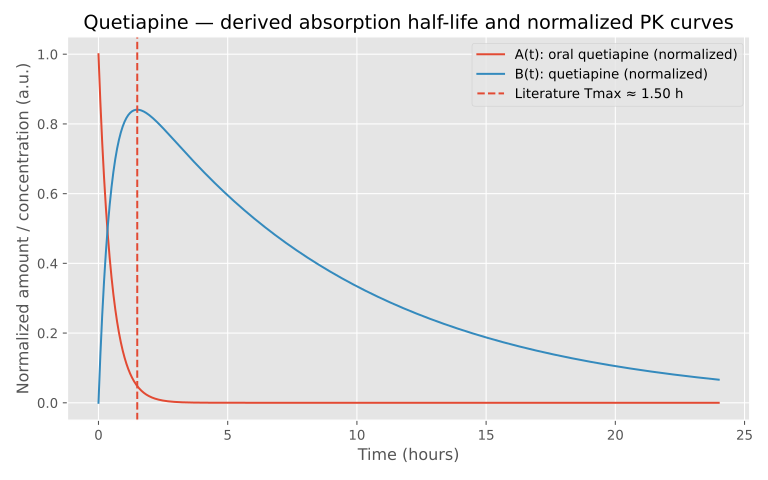
Ausgabe:
T_BC = 6.0 h, Tmax = 1.5 h
Computed uptake half-life T_AB ≈ 0.3424 h (20.5 min)
kf = 2.0246 1/h, ke = 0.1155 1/h#!/usr/bin/env python3
import numpy as np, math
import matplotlib.pyplot as plt
plt.style.use("ggplot")
from scipy.special import lambertw
ln2 = math.log(2.0)
T_BC_hours = 6.0 # quetiapine elimination half-life (B -> elimination)
t_peak_hours = 1.5 # Tmax (time to peak plasma concentration)
def compute_T_AB(T_BC, t_peak):
"""Return uptake half-life T_AB from T_BC and t_peak.
Uses Lambert W if SciPy is available; otherwise bisection on a=ln r/(r-1)."""
if T_BC <= 0 or t_peak <= 0:
raise ValueError("T_BC and t_peak must be positive.")
a = ln2 * t_peak / T_BC
if abs(a - 1.0) <= 1e-12:
return T_BC # equal rates case
# Compute using Lambert W (SciPy present)
z = -a * math.exp(-a)
branch = 0 if a > 1 else -1
W = lambertw(z, branch)
return float(-(ln2 * t_peak) / W.real)
# Compute half-lives and rates
T_AB_hours = compute_T_AB(T_BC_hours, t_peak_hours)
ke = ln2 / T_BC_hours
kf = ln2 / T_AB_hours
print(f"T_BC = {T_BC_hours} h, Tmax = {t_peak_hours} h")
print(f"Computed uptake half-life T_AB ≈ {T_AB_hours:.4f} h ({T_AB_hours*60:.1f} min)")
print(f"kf = {kf:.4f} 1/h, ke = {ke:.4f} 1/h")
# Time grid and normalized amounts (A(0)=1)
t = np.linspace(0.0, 24.0, 1000) # hours
A = np.exp(-kf * t)
B = (kf / (ke - kf)) * (np.exp(-kf * t) - np.exp(-ke * t)) # normalized Bateman form
# Plot
plt.figure(figsize=(8,5))
plt.plot(t, A, label="A(t): oral quetiapine (normalized)")
plt.plot(t, B, label="B(t): quetiapine (normalized)")
plt.axvline(t_peak_hours, linestyle="--", label=f"Literature Tmax ≈ {t_peak_hours:.2f} h")
plt.xlabel("Time (hours)")
plt.ylabel("Normalized amount / concentration (a.u.)")
plt.title("Quetiapine — derived uptake half-life and normalized PK curves")
plt.legend()
plt.tight_layout()
plt.savefig("Quetiapine pharmacokinetics.svg")