
Mujoco + GLFW-Beispiel mit Gelenkraum-Schiebereglern mittels Dear imgui
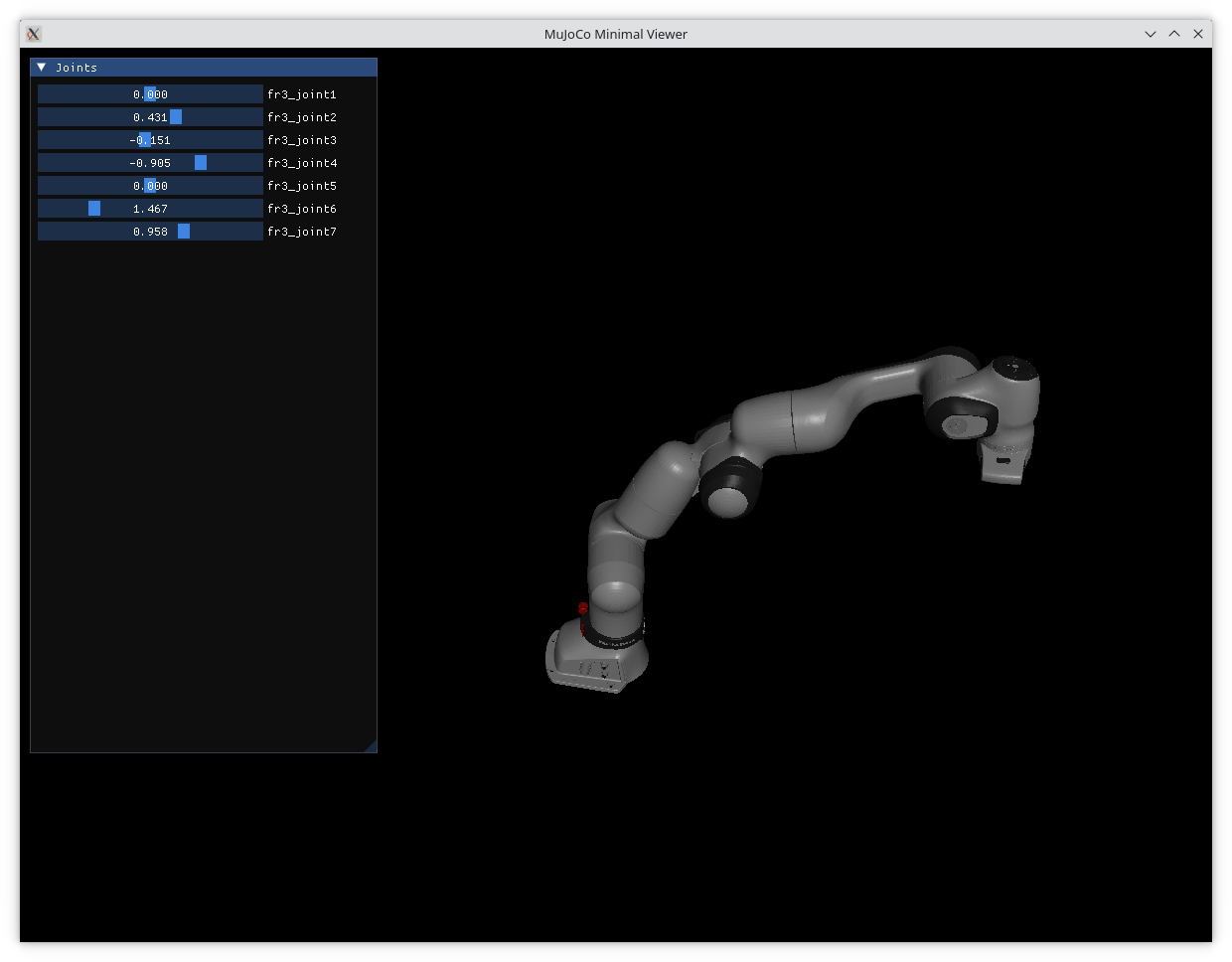
In unserem vorherigen Post [Minimaler C++ Mujoco-Szene-Viewer mit Maus-Navigation & Simulation](/2025/09/11/minimal-c-mujoco-scene-viewer-with-mouse-navigation & simulation/) haben wir demonstriert, wie man einen einfachen Mujoco-Viewer mit GLFW für Fensterverwaltung und OpenGL für Rendering einrichtet. In diesem Post werden wir dieses Beispiel erweitern, indem wir Dear ImGui integrieren, um eine Benutzeroberfläche mit Schiebereglern zu erstellen, die es uns ermöglichen, die Gelenkpositionen eines Robotermodells in Echtzeit zu steuern.
Voraussetzungen
run_mujoco_glfw.sh
git submodule add https://github.com/ocornut/imgui.gitmain.cpp
main.cpp
#include <mujoco/mujoco.h>
#include <GLFW/glfw3.h>
#include <GL/gl.h>
#include "imgui/imgui.h"
#include "imgui/backends/imgui_impl_glfw.h"
#include "imgui/backends/imgui_impl_opengl2.h"
#include <cstdio>
#include <cstdlib>
#include <cmath>
#include <time.h>
#include <vector>
#include <string>
#include <algorithm>

// --- Globals kept tiny for GLFW callbacks ---
static mjModel* m = nullptr;
static mjData*  d = nullptr;

static mjvCamera cam;       // abstract camera
static mjvOption opt;       // visualization options
static mjvScene  scn;       // abstract scene
static mjrContext con;      // custom GPU context

static bool  button_left = false, button_middle = false, button_right = false;
static double lastx = 0, lasty = 0;
// Real-time sync: record simulation and wall-clock start times
static double sim_start_time = 0.0;
static double realtime_start = 0.0;

// --- Simple UI state for sliders ---
struct SliderDef {
  int jnt;           // joint index this slider group belongs to
  int comp;          // component within joint: -1 for hinge/slide, 0..2 Euler for ball, 0..5 (xyz,rpy) for free
  double vmin;       // minimum slider value (units: m or rad)
  double vmax;       // maximum slider value
  double value;      // current value
  std::string label; // label (not rendered as text in this minimal UI)
};

static std::vector<SliderDef> g_sliders;   // all sliders

// Utilities: clamp
template <typename T>
static inline T clamp(T v, T lo, T hi) { return std::max(lo, std::min(v, hi)); }

// Quaternion helpers (ZYX yaw-pitch-roll convention)
static void quat_normalize(double q[4]) {
  double n = std::sqrt(q[0]*q[0] + q[1]*q[1] + q[2]*q[2] + q[3]*q[3]);
  if (n <= 0) { q[0]=1; q[1]=q[2]=q[3]=0; return; }
  q[0]/=n; q[1]/=n; q[2]/=n; q[3]/=n;
}

static void euler_rpy_to_quat(double roll, double pitch, double yaw, double q[4]) {
  double cr = std::cos(roll*0.5),  sr = std::sin(roll*0.5);
  double cp = std::cos(pitch*0.5), sp = std::sin(pitch*0.5);
  double cy = std::cos(yaw*0.5),   sy = std::sin(yaw*0.5);
  // ZYX order: q = Rz(yaw)*Ry(pitch)*Rx(roll)
  q[0] = cr*cp*cy + sr*sp*sy; // w
  q[1] = sr*cp*cy - cr*sp*sy; // x
  q[2] = cr*sp*cy + sr*cp*sy; // y
  q[3] = cr*cp*sy - sr*sp*cy; // z
  quat_normalize(q);
}

static void quat_to_euler_rpy(const double qin[4], double& roll, double& pitch, double& yaw) {
  double q[4] = {qin[0], qin[1], qin[2], qin[3]};
  quat_normalize(q);
  // roll (x-axis rotation)
  double sinr_cosp = 2.0*(q[0]*q[1] + q[2]*q[3]);
  double cosr_cosp = 1.0 - 2.0*(q[1]*q[1] + q[2]*q[2]);
  roll = std::atan2(sinr_cosp, cosr_cosp);
  // pitch (y-axis)
  double sinp = 2.0*(q[0]*q[2] - q[3]*q[1]);
  if (std::abs(sinp) >= 1.0) pitch = std::copysign(M_PI/2.0, sinp);
  else pitch = std::asin(sinp);
  // yaw (z-axis)
  double siny_cosp = 2.0*(q[0]*q[3] + q[1]*q[2]);
  double cosy_cosp = 1.0 - 2.0*(q[2]*q[2] + q[3]*q[3]);
  yaw = std::atan2(siny_cosp, cosy_cosp);
}

// Build sliders from model and current data
static void build_sliders() {
  g_sliders.clear();
  if (!m || !d) return;
  for (int j=0; j<m->njnt; ++j) {
    int type = m->jnt_type[j];
    int qadr = m->jnt_qposadr[j];
    const char* name = (m->names && m->name_jntadr) ? m->names + m->name_jntadr[j] : "joint";
    if (type == mjJNT_HINGE) {
      double vmin = -M_PI, vmax = M_PI;
      if (m->jnt_limited[j]) { vmin = m->jnt_range[2*j]; vmax = m->jnt_range[2*j+1]; }
      g_sliders.push_back({j, -1, vmin, vmax, d->qpos[qadr], std::string(name)});
    } else if (type == mjJNT_SLIDE) {
      double vmin = -1.0, vmax = 1.0;
      if (m->jnt_limited[j]) { vmin = m->jnt_range[2*j]; vmax = m->jnt_range[2*j+1]; }
      g_sliders.push_back({j, -1, vmin, vmax, d->qpos[qadr], std::string(name)});
    } else if (type == mjJNT_BALL) {
      double q[4] = { d->qpos[qadr+0], d->qpos[qadr+1], d->qpos[qadr+2], d->qpos[qadr+3] };
      double r,p,y; quat_to_euler_rpy(q, r,p,y);
      g_sliders.push_back({j, 0, -M_PI, M_PI, r, std::string(name)+".roll"});
      g_sliders.push_back({j, 1, -M_PI, M_PI, p, std::string(name)+".pitch"});
      g_sliders.push_back({j, 2, -M_PI, M_PI, y, std::string(name)+".yaw"});
    } else if (type == mjJNT_FREE) {
      // position xyz
      g_sliders.push_back({j, 0, -2.0, 2.0, d->qpos[qadr+0], std::string(name)+".x"});
      g_sliders.push_back({j, 1, -2.0, 2.0, d->qpos[qadr+1], std::string(name)+".y"});
      g_sliders.push_back({j, 2, -2.0, 2.0, d->qpos[qadr+2], std::string(name)+".z"});
      double q[4] = { d->qpos[qadr+3], d->qpos[qadr+4], d->qpos[qadr+5], d->qpos[qadr+6] };
      double r,p,y; quat_to_euler_rpy(q, r,p,y);
      g_sliders.push_back({j, 3, -M_PI, M_PI, r, std::string(name)+".roll"});
      g_sliders.push_back({j, 4, -M_PI, M_PI, p, std::string(name)+".pitch"});
      g_sliders.push_back({j, 5, -M_PI, M_PI, y, std::string(name)+".yaw"});
    }
  }
}

// Apply slider values to qpos and forward kinematics
static void apply_sliders_to_qpos() {
  if (!m || !d) return;
  // Start from current qpos
  // For each joint, write values
  for (size_t i=0; i<g_sliders.size(); ++i) {
    const SliderDef& s = g_sliders[i];
    int type = m->jnt_type[s.jnt];
    int qadr = m->jnt_qposadr[s.jnt];
    if (type == mjJNT_HINGE || type == mjJNT_SLIDE) {
      d->qpos[qadr] = s.value;
    } else if (type == mjJNT_BALL) {
      // Find the three sliders for this joint
      double r=0,p=0,y=0;
      for (const auto& t : g_sliders) if (t.jnt==s.jnt) {
        if (t.comp==0) r=t.value; else if (t.comp==1) p=t.value; else if (t.comp==2) y=t.value;
      }
      double q[4]; euler_rpy_to_quat(r,p,y,q);
      d->qpos[qadr+0]=q[0]; d->qpos[qadr+1]=q[1]; d->qpos[qadr+2]=q[2]; d->qpos[qadr+3]=q[3];
    } else if (type == mjJNT_FREE) {
      double pos[3]; double r=0,p=0,y=0;
      for (const auto& t : g_sliders) if (t.jnt==s.jnt) {
        if (t.comp==0) pos[0]=t.value; else if (t.comp==1) pos[1]=t.value; else if (t.comp==2) pos[2]=t.value;
        else if (t.comp==3) r=t.value; else if (t.comp==4) p=t.value; else if (t.comp==5) y=t.value;
      }
      double q[4]; euler_rpy_to_quat(r,p,y,q);
      d->qpos[qadr+0]=pos[0]; d->qpos[qadr+1]=pos[1]; d->qpos[qadr+2]=pos[2];
      d->qpos[qadr+3]=q[0];  d->qpos[qadr+4]=q[1];  d->qpos[qadr+5]=q[2];  d->qpos[qadr+6]=q[3];
    }
  }
  mj_forward(m, d);
}

// No custom overlay; ImGui will handle all UI rendering and interactions

// --- GLFW error callback ---
static void glfw_error_callback(int error, const char* description) {
  std::fprintf(stderr, "GLFW error %d: %s\n", error, description);
}

// --- Mouse button: remember which buttons are down ---
static void mouse_button_callback(GLFWwindow* window, int button, int act, int /*mods*/) {
  // Simple, stable button state handling
  if (button == GLFW_MOUSE_BUTTON_LEFT)   button_left   = (act == GLFW_PRESS) ? true : (act == GLFW_RELEASE ? false : button_left);
  if (button == GLFW_MOUSE_BUTTON_MIDDLE) button_middle = (act == GLFW_PRESS) ? true : (act == GLFW_RELEASE ? false : button_middle);
  if (button == GLFW_MOUSE_BUTTON_RIGHT)  button_right  = (act == GLFW_PRESS) ? true : (act == GLFW_RELEASE ? false : button_right);

  // Record current cursor position (window coordinates)
  glfwGetCursorPos(window, &lastx, &lasty);
}

// --- Mouse move: convert motion to camera action ---
static void cursor_pos_callback(GLFWwindow* window, double xpos, double ypos) {
  if (!m) return;
  // If no mouse button is pressed, just update last position
  if (!button_left && !button_right && !button_middle) {
    lastx = xpos;
    lasty = ypos;
    return;
  }

  // If ImGui wants the mouse, don't move camera
  if (ImGui::GetIO().WantCaptureMouse) {
    lastx = xpos; lasty = ypos;
    return;
  }

  // Compute motion in window coordinates, normalize by framebuffer height (stable across DPI)
  int fbw = 0, fbh = 1;
  glfwGetFramebufferSize(window, &fbw, &fbh);
  if (fbh <= 0) fbh = 1;

  double dx = (xpos - lastx) / (double)fbh;
  double dy = (ypos - lasty) / (double)fbh;
  lastx = xpos;
  lasty = ypos;

  if (button_left) {
    // Left-drag: rotate
    mjv_moveCamera(m, mjMOUSE_ROTATE_H, dx, dy, &scn, &cam);
  } else if (button_right) {
    // Right-drag: pan horizontally
    mjv_moveCamera(m, mjMOUSE_MOVE_H, dx, dy, &scn, &cam);
  } else if (button_middle) {
    // Middle-drag: zoom
    mjv_moveCamera(m, mjMOUSE_ZOOM, dx, dy, &scn, &cam);
  }
}

// --- Scroll wheel zoom ---
static void scroll_callback(GLFWwindow* window, double /*xoffset*/, double yoffset) {
  if (!m) return;
  // Scroll to zoom (gentle factor)
  mjv_moveCamera(m, mjMOUSE_ZOOM, 0, -0.05 * yoffset, &scn, &cam);
}

// --- Key: 'R' to reset ---
static void key_callback(GLFWwindow* window, int key, int scancode, int act, int mods) {
  if (act == GLFW_PRESS || act == GLFW_REPEAT) {
    if (key == GLFW_KEY_R) {
      // Reset simulation state and real-time timers so the sim doesn't jump ahead
      mj_resetData(m, d);
      sim_start_time = (d ? d->time : 0.0);
      realtime_start = glfwGetTime();
  // Rebuild and resync sliders from the reset state
  build_sliders();
  apply_sliders_to_qpos();
    }
    if (key == GLFW_KEY_ESCAPE) glfwSetWindowShouldClose(window, GLFW_TRUE);
  }
}

int main(int argc, char** argv) {
  // Usage
  if (argc < 2) {
    std::printf("Usage: %s model.xml\n", argv[0]);
    return 1;
  }

  // (Open-source MuJoCo >= 2.2 has no license activation step)

  // Load model
  char error[1024] = {0};
  m = mj_loadXML(argv[1], nullptr, error, sizeof(error));
  if (!m) {
    std::fprintf(stderr, "Could not load model: %s\n", error);
    return 1;
  }
  d = mj_makeData(m);

  // Init GLFW
  glfwSetErrorCallback(glfw_error_callback);
  if (!glfwInit()) {
    std::fprintf(stderr, "Could not initialize GLFW\n");
    return 1;
  }

  // Create window/context
  glfwWindowHint(GLFW_DOUBLEBUFFER, 1);
  GLFWwindow* window = glfwCreateWindow(1200, 900, "MuJoCo Minimal Viewer", nullptr, nullptr);
  if (!window) {
    std::fprintf(stderr, "Could not create GLFW window\n");
    glfwTerminate();
    return 1;
  }
  glfwMakeContextCurrent(window);
  glfwSwapInterval(0); // disable vsync

  // Set callbacks
  glfwSetMouseButtonCallback(window, mouse_button_callback);
  glfwSetCursorPosCallback(window, cursor_pos_callback);
  glfwSetScrollCallback(window, scroll_callback);
  glfwSetKeyCallback(window, key_callback);

  // Init MuJoCo visualization
  mjv_defaultCamera(&cam);
  // Set camera look-at point so the initial view is centered on the model
  cam.lookat[0] = 0.0;
  cam.lookat[1] = 0.0;
  cam.lookat[2] = 0.5;
  mjv_defaultOption(&opt);
  mjv_defaultScene(&scn);
  mjr_defaultContext(&con);

  mjv_makeScene(m, &scn, 2000);               // allocate scene
  mjr_makeContext(m, &con, mjFONTSCALE_100);  // allocate GPU context

  // Initialize real-time sync timers (start both at the same wall-clock time)
  sim_start_time = d->time;
  realtime_start = glfwGetTime();

  // Build initial sliders from model
  build_sliders();
  apply_sliders_to_qpos();

  // --- ImGui setup ---
  IMGUI_CHECKVERSION();
  ImGui::CreateContext();
  ImGuiIO& io = ImGui::GetIO(); (void)io;
  ImGui::StyleColorsDark();
  ImGui_ImplGlfw_InitForOpenGL(window, true);
  ImGui_ImplOpenGL2_Init();

  // Place camera to show entire model
  cam.type = mjCAMERA_FREE;
  mj_forward(m, d);

  // Main loop
  while (!glfwWindowShouldClose(window)) {
  // Simulation disabled: directly use slider-set qpos and keep mj_forward up to date
  // In case something external changed d->qpos, we could re-apply every frame; cheap enough
  apply_sliders_to_qpos();

    // Get framebuffer size and set viewport
    int width, height;
    glfwGetFramebufferSize(window, &width, &height);
    mjrRect viewport = {0, 0, width, height};

    // Update scene and render
    mjv_updateScene(m, d, &opt, nullptr, &cam, mjCAT_ALL, &scn);
    mjr_render(viewport, &scn, &con);

    // ImGui UI
    ImGui_ImplOpenGL2_NewFrame();
    ImGui_ImplGlfw_NewFrame();
    ImGui::NewFrame();

    ImGui::SetNextWindowPos(ImVec2(10, 10), 0);
    ImGui::SetNextWindowSize(ImVec2(350, std::min(700, height-20)), 0);
    if (ImGui::Begin("Joints", nullptr, 0)) {
      for (size_t i=0; i<g_sliders.size(); ++i) {
        SliderDef& s = g_sliders[i];
        float v = (float)s.value;
        float vmin = (float)s.vmin;
        float vmax = (float)s.vmax;
        std::string lab = s.label;
        if (ImGui::SliderFloat(lab.c_str(), &v, vmin, vmax)) {
          s.value = v;
        }
      }
    }
    ImGui::End();

    // Apply slider changes and render UI on top
    apply_sliders_to_qpos();
    ImGui::Render();
    ImGui_ImplOpenGL2_RenderDrawData(ImGui::GetDrawData());

    // Swap & poll
    glfwSwapBuffers(window);
    glfwPollEvents();
  }

  // Cleanup
  mjr_freeContext(&con);
  mjv_freeScene(&scn);
  mj_deleteData(d);
  mj_deleteModel(m);
  // ImGui shutdown
  ImGui_ImplOpenGL2_Shutdown();
  ImGui_ImplGlfw_Shutdown();
  ImGui::DestroyContext();
  glfwTerminate();
  return 0;
}CMakeLists.txt
CMakeLists.txt
cmake_minimum_required(VERSION 3.10)
project(mujocotest)

set(CMAKE_CXX_STANDARD 17)
set(CMAKE_CXX_STANDARD_REQUIRED ON)
set(CMAKE_CXX_EXTENSIONS OFF)

find_package(PkgConfig REQUIRED)
pkg_search_module(MUJOCO mujoco)
pkg_search_module(GLFW REQUIRED glfw3)

# Prefer GLVND on systems that support it. If you need the legacy loader, set
# OpenGL_GL_PREFERENCE to "LEGACY" on the cmake command line or in the cache.
set(OpenGL_GL_PREFERENCE "GLVND" CACHE STRING "Prefer GLVND or LEGACY for OpenGL loader")

find_package(OpenGL REQUIRED)

if(NOT MUJOCO_FOUND)
	set(MUJOCO_INCLUDE_DIRS /opt/mujoco/include)
	set(MUJOCO_LIBRARIES /opt/mujoco/lib/libmujoco.so)
endif()

add_executable(mujocotest main.cpp)
target_include_directories(mujocotest PRIVATE ${MUJOCO_INCLUDE_DIRS} ${GLFW_INCLUDE_DIRS} ${CMAKE_CURRENT_SOURCE_DIR}/imgui ${CMAKE_CURRENT_SOURCE_DIR}/imgui/backends)

set(IMGUI_SOURCES
	${CMAKE_CURRENT_SOURCE_DIR}/imgui/imgui.cpp
	${CMAKE_CURRENT_SOURCE_DIR}/imgui/imgui_draw.cpp
	${CMAKE_CURRENT_SOURCE_DIR}/imgui/imgui_tables.cpp
	${CMAKE_CURRENT_SOURCE_DIR}/imgui/imgui_widgets.cpp
	${CMAKE_CURRENT_SOURCE_DIR}/imgui/backends/imgui_impl_glfw.cpp
	${CMAKE_CURRENT_SOURCE_DIR}/imgui/backends/imgui_impl_opengl2.cpp
)

target_sources(mujocotest PRIVATE ${IMGUI_SOURCES})
target_link_libraries(mujocotest PRIVATE ${MUJOCO_LIBRARIES} ${GLFW_LIBRARIES} OpenGL::GL)Bauen und Ausführen
build_and_run_mujoco_imgui.sh
mkdir build
cmake .
make
./mujocotest ~/mujoco_menagerie/franka_fr3/fr3.xmlIf this post helped you, please consider buying me a coffee or donating via PayPal to support research & publishing of new posts on TechOverflow