
Python: Pufferkapazität mit UliEngineering berechnen
Du kannst leicht die Pufferkapazität mit der UliEngineering-Python-Bibliothek berechnen:
from UliEngineering.Chemistry.Henderson import buffer_capacity

# Pufferkapazität für 0,1M Acetatpuffer bei pH 4,76 berechnen
capacity = buffer_capacity(0.1, 4.76, 4.76)
print(f"Pufferkapazität (0,1M, pH=pKa): {capacity:.3f}")

# Pufferkapazität für 0,1M Acetatpuffer bei pH 4,5 berechnen
capacity = buffer_capacity(0.1, 4.5, 4.76)
print(f"Pufferkapazität (0,1M, pH 4,5): {capacity:.3f}")

# Pufferkapazität für 0,2M Phosphatpuffer bei pH 7,2 berechnen
capacity = buffer_capacity(0.2, 7.2, 7.2)
print(f"Pufferkapazität (0,2M, pH=pKa): {capacity:.3f}")Beispielausgabe
Pufferkapazität (0,1M, pH=pKa): 0.058
Pufferkapazität (0,1M, pH 4,5): 0.057
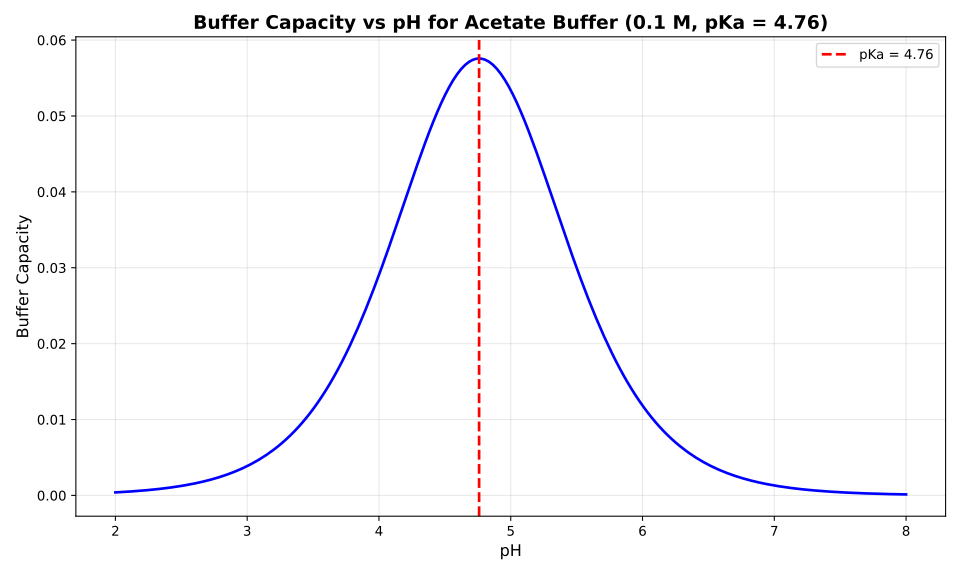
Pufferkapazität (0,2M, pH=pKa): 0.115Die Pufferkapazitätsberechnung bestimmt, wie effektiv eine Pufferlösung pH-Änderungen widersteht, wenn Säure oder Base hinzugefügt wird. Dies ist wesentlich für Pufferdesign, biochemische Anwendungen und die Aufrechterhaltung eines stabilen pH-Werts in chemischen Prozessen. Die Pufferkapazität ist maximal, wenn der pH-Wert der Lösung dem pKa der schwachen Säure entspricht, und steigt mit höherer Gesamtpufferkonzentration.
Die Pufferkapazität wird mit der Formel $\beta = 2.303 \times C_{total} \times \frac{K_a \times [H^+]}{(K_a + [H^+])^2}$ berechnet, wobei $\beta$ die Pufferkapazität, $C_{total}$ die Gesamtkonzentration des Puffers (Säure + konjugierte Base), $K_a$ die Säuredissoziationskonstante und $[H^+]$ die Wasserstoffionenkonzentration ist. Höhere Werte zeigen einen größeren Widerstand gegen pH-Änderungen.
Das obige Diagramm zeigt die Pufferkapazität in Abhängigkeit des pH-Werts für einen 0,1 M Acetatpuffer mit pKa = 4,76. Beachte die charakteristische glockenförmige Kurve, die bei pH = pKa ihr Maximum erreicht, wo die Pufferkapazität am größten ist. Dies zeigt, warum Puffer am effektivsten sind, wenn der pH-Wert nahe am pKa der schwachen Säure liegt.
Verwandte Beiträge
- How to compute Henderson-Hasselbalch pH in Python using UliEngineering
- How to compute Henderson-Hasselbalch pKa in Python using UliEngineering
- How to compute molarity from moles and volume in Python using UliEngineering
Diagramm-Estellungsskript
#!/usr/bin/env python3
import matplotlib.pyplot as plt
import numpy as np
import sys
sys.path.insert(0, '/home/uli/dev/UliEngineering')

from UliEngineering.Chemistry.Henderson import buffer_capacity

# pH-Bereich für das Diagramm
pH = np.linspace(2, 8, 200)  # pH 2 bis 8

# Diagramm erstellen
plt.figure(figsize=(10, 6))

# Pufferkapazität für Acetatpuffer berechnen (pKa = 4,76, C_total = 0,1 M)
pKa = 4.76
C_total = 0.1

# Ka aus pKa berechnen
Ka = 10 ** (-pKa)

# H+-Konzentration aus pH berechnen
H = 10 ** (-pH)

# Pufferkapazität berechnen
beta = 2.303 * C_total * (Ka * H) / (Ka + H) ** 2

plt.plot(pH, beta, color='blue', linewidth=2)
plt.xlabel('pH', fontsize=12)
plt.ylabel('Pufferkapazität', fontsize=12)
plt.title('Pufferkapazität vs. pH für Acetatpuffer (0,1 M, pKa = 4,76)', fontsize=14, fontweight='bold')
plt.grid(True, alpha=0.3)

# pKa markieren
plt.axvline(x=pKa, color='red', linestyle='--', linewidth=2, label=f'pKa = {pKa}')
plt.legend(loc='upper right', fontsize=10)

plt.tight_layout()
plt.savefig('buffer_capacity_plot.svg', format='svg', dpi=300)