


你可以使用 UliEngineering Python 库轻松计算雷诺数。雷诺数是一个无量纲量,用于预测流体动力学中的流动模式:
Σ
TechOverflow calculators:
You can enter values with SI suffixes like 12.2m (equivalent to 0.012) or 14k (14000) or 32u (0.000032).
The results are calculated while you type and shown directly below the calculator, so there is no need to press return or click on a Calculate button.
You can enter values with SI suffixes like 12.2m (equivalent to 0.012) or 14k (14000) or 32u (0.000032).
The results are calculated while you type and shown directly below the calculator, so there is no need to press return or click on a Calculate button.
kg/m³
⚠
m/s
⚠
m
⚠
Pa·s
⚠
reynolds_number.py
from UliEngineering.Physics.Viscosity import reynolds_number
from UliEngineering.EngineerIO import *

# 计算管道中水流的雷诺数
density = 998.2  # kg/m³(水)
velocity = 1.0  # m/s
characteristic_length = 0.01  # 1 cm(管道直径)
viscosity = 0.001  # Pa·s(水)

Re = reynolds_number(density, velocity, characteristic_length, viscosity)
print(f"Reynolds number: {Re:.0f}")

# 计算气流的雷诺数
density = 1.225  # kg/m³(空气)
velocity = 10.0  # m/s
characteristic_length = 0.1  # 10 cm
viscosity = 1.8e-5  # Pa·s(空气)

Re = reynolds_number(density, velocity, characteristic_length, viscosity)
print(f"Air Reynolds number: {Re:.0f}")

# 计算甘油流动的雷诺数
density = 1261.0  # kg/m³(甘油)
velocity = 0.1  # m/s
characteristic_length = 0.01  # 1 cm
viscosity = 1.412  # Pa·s(甘油)

Re = reynolds_number(density, velocity, characteristic_length, viscosity)
print(f"Glycerol Reynolds number: {Re:.0f}")
示例输出
reynolds_number_output.txt
Reynolds number: 9982
Air Reynolds number: 68083
Glycerol Reynolds number: 9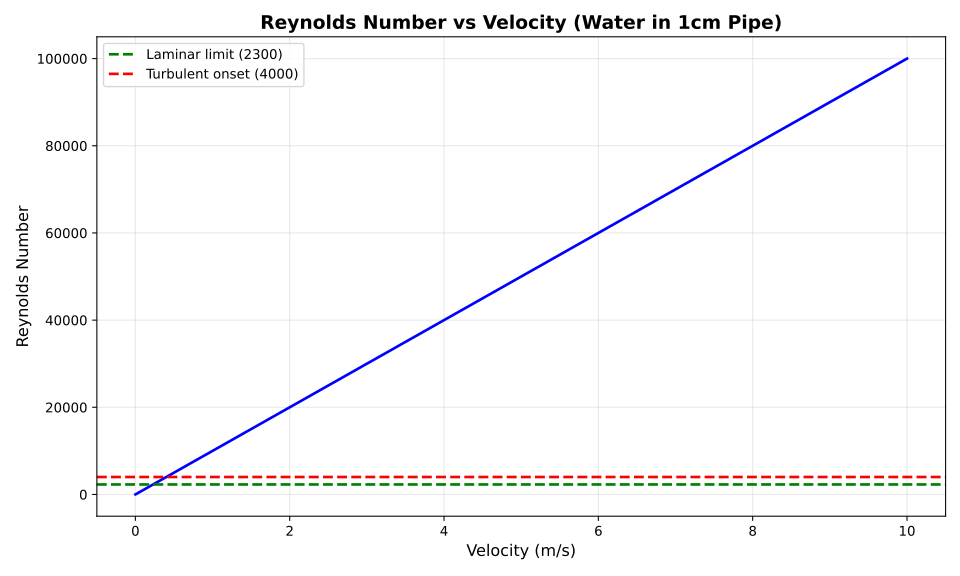
雷诺数的表达式为:
$$ Re = \frac{\rho v L}{\eta} $$其中 $Re$ 是雷诺数,$\rho$ 是流体密度,$v$ 是流速,$L$ 是特征长度(例如管道直径),$\eta$ 是动力粘度。
雷诺数可用于判断流动是层流还是湍流:
- Re < 2300:层流(平滑、有序)
- 2300 < Re < 4000:过渡流
- Re > 4000:湍流(混乱、混合)
上图展示了水在直径 1 cm 的管道中流动时,雷诺数随流速的变化情况。Re = 2300 处的绿色虚线标记了从层流向过渡流转变的临界点,而 Re = 4000 处的红色虚线标记了湍流的起始点。
雷诺数是流体力学的基础,广泛应用于管道流动分析、空气动力学、传热学等众多工程领域。它表示流体中惯性力与粘性力的比值。
相关文章
- 如何使用 UliEngineering 在 Python 中计算运动粘度
- 如何使用 UliEngineering 在 Python 中计算泊肃叶流量
- 如何使用 UliEngineering 在 Python 中计算斯托克斯阻力
绘图生成脚本
plot_reynolds.py
#!/usr/bin/env python3
import matplotlib.pyplot as plt
import numpy as np
import sys
sys.path.insert(0, '/home/uli/dev/UliEngineering')

from UliEngineering.Physics.Viscosity import reynolds_number

# 用于绘图的流速范围
v = np.linspace(0.001, 10, 100)  # 0.001 到 10 m/s

# 创建图形
plt.figure(figsize=(10, 6))

# 固定参数(管道中类似水的流动)
density = 1000.0  # kg/m³
characteristic_length = 0.01  # 1 cm(管道直径)
viscosity = 0.001  # Pa·s

# 计算雷诺数
Re = reynolds_number(density, v, characteristic_length, viscosity)

plt.plot(v, Re, color='blue', linewidth=2)
plt.xlabel('速度 (m/s)', fontsize=12)
plt.ylabel('雷诺数', fontsize=12)
plt.title('雷诺数 vs Velocity (Water in 1cm Pipe)', fontsize=14, fontweight='bold')
plt.grid(True, alpha=0.3)

# 添加层流/湍流转变线
plt.axhline(y=2300, color='green', linestyle='--', linewidth=2, label='层流极限 (2300)')
plt.axhline(y=4000, color='red', linestyle='--', linewidth=2, label='湍流起始 (4000)')
plt.legend(loc='upper left', fontsize=10)

plt.tight_layout()
plt.savefig('reynolds_plot.svg', format='svg', dpi=300)
print("图表已保存到 reynolds_plot.svg")如果这篇文章对您有帮助,请考虑请我喝杯咖啡或通过 PayPal 捐款,以支持 TechOverflow 上新文章的研究与发布
